
For years we have associated eCommerce with a website with products, a shopping cart and a payment gateway. And of course this still exists, but in many sectors digital commerce has long ceased to be a simple commercial layer.
When you work with industry, technical distribution or specialized retail, eCommerce ends up being part of the company’s operational chain. It shares data with the ERP, depends on stocks, coexists with various commercial channels and must fit in with suppliers, logistics operators and marketplaces.
It’s funny because many companies still propose these projects from the web, when in reality the interesting part tends to be in everything that happens behind the web.
When eCommerce coexists with marketplaces and digital distribution
We are currently working with a Catalan industrial company linked to the energy sector. A company with a very solid internal structure, mature processes and a corporate ERP centralizing practically all business operations.
At first glance it might seem like the typical project where you just need to connect products and start selling online. But the reality was much more interesting.
The company already operated with several digital channels and was clear that eCommerce had to be able to coexist, in the medium term, with marketplaces and external platforms. This implied approaching the project with data synchronization, shared stock, different catalog structures depending on the channel and very diverse commercial circuits. In this case, the solution chosen was LogiCommerce due to its potential in b2b cases.
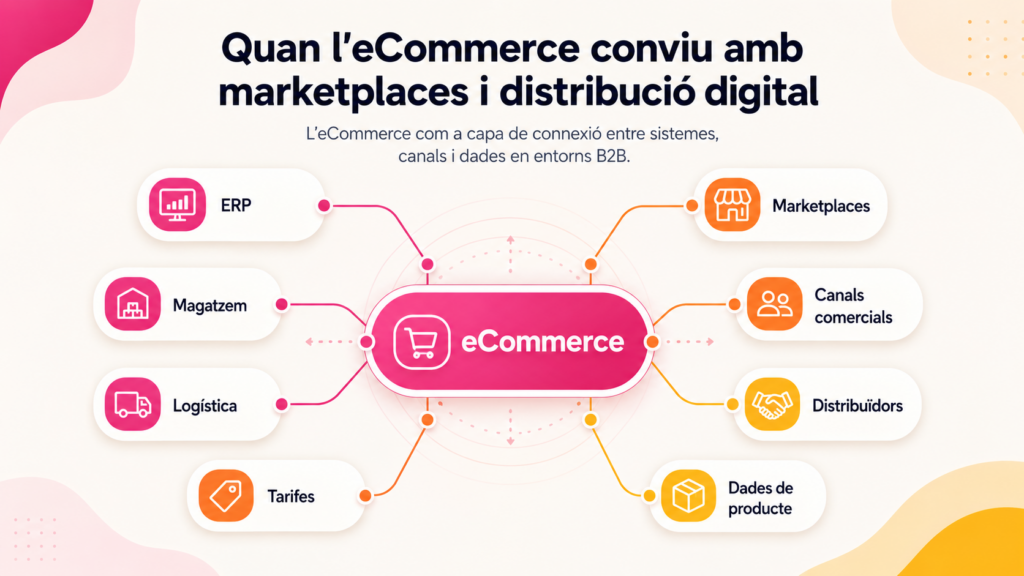
Because when an eCommerce enters this type of ecosystem, it ceases to be just an online store. It becomes a connection layer between several systems:
- ERP.
- Logistics.
- Marketplaces.
- Commercial channels.
- Rates.
- Distributors.
- Product data.
And here a fairly common reality appears in B2B environments: the visible platform is probably the simplest part of the entire project.
eCommerce as an extension of a larger commercial network
Let’s tackle another real project: with a Valencian hardware store with thousands of references and an operation completely conditioned by its sector.
In this case, the company worked with an ERP specialized in hardware and technical distribution. A less spectacular system from a technological point of view, but absolutely integrated with the reality of the business and with its entire network of suppliers and purchasing centers.
In fact, one of the most interesting parts of the project was precisely this: understanding that eCommerce was not an independent channel, but the last leg of a much larger commercial chain.
Products, data, stocks and a good part of the commercial information were already circulating through the ERP itself. And that is why the existing connector with WooCommerce ended up having much more strategic value than it might initially seem. Therefore, in this case, we opted for WooCommerce .
Sometimes, in digital transformation, there is a certain tendency to want to rebuild everything from scratch. And honestly, there are sectors where understanding what already works is much more useful than trying to impress anyone technically.
ERP, logistics and eCommerce: the same conversation
There’s an idea that appears in practically any B2B eCommerce project with a little depth: eCommerce ends up speaking the same language as ERP.
Because when volume grows, digital commerce stops revolving only around the web and many other business layers begin to come into play: stock synchronization, complex rates according to customer or channel, real product availability, commercial management, logistics, orders, traceability or simultaneous coexistence between B2B, B2C and marketplaces.
And this is where eCommerce ceases to be solely a matter of marketing or recruitment. It ends up forming part of the company’s operational infrastructure and sharing space with systems that, until relatively recently, seemed very far from the digital world.
Think eCommerce from the supply chain
For a long time the usual question was “which platform will we use?” WooCommerce, Shopify, Prestashop, Magento or custom development. And recently LogiCommerce has been added.
Today, in many sectors, the conversation is different. The relevant part tends to be how all the departments and internal processes coexist.
That’s why many of the most interesting eCommerce projects currently have more to do with operational architecture than with the web itself.
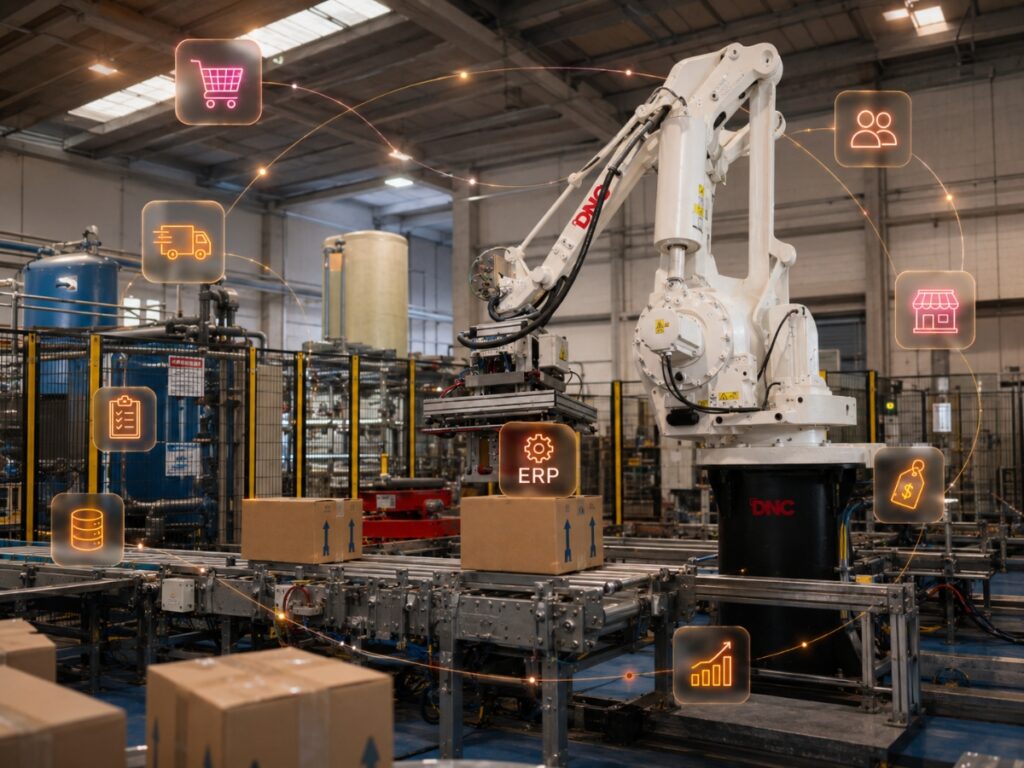
Because a modern eCommerce is no longer just a digital storefront. It is another piece in the company’s digital supply chain.
