
Artificial intelligence can answer questions, analyze information, and generate content. However, by default, it does not know a company’s internal data: it doesn’t know what stock is available, which orders are pending, or a customer’s history.
This information is found in systems such as ERP, CRM, eCommerce, or other corporate applications. For AI to be able to query and use it, these systems must be connected. MCP is one of the technologies that makes this possible.
What is MCP?
MCP stands for Model Context Protocol. It is a standard that allows an artificial intelligence application to see what data and tools it has available and how it should use them.
Put simply, MCP helps AI understand that it can, for example, check stock, look up a customer, review an order, or create a sales opportunity.
MCP does not necessarily store this data. Its function is to tell the AI where to find it and what tool to use to access it.
What role does the API play?
An API is the gateway that allows one program to access the data or functions of another system.
For example, an ERP’s API can allow querying stock, retrieving an invoice, or creating an order. Other applications can use this gateway to communicate with the ERP without a person having to enter it manually.
What is the difference between an API and MCP?
The API provides technical access to a system. MCP presents this access in a structured way so that an artificial intelligence application knows when and how to use it.
We can summarize it like this:
The ERP or CRM contains the data, the API allows access to it, and MCP helps the AI understand which data it can query and which actions it can execute.
MCP, therefore, does not replace the API. Usually, it uses it to reach the system containing the information.
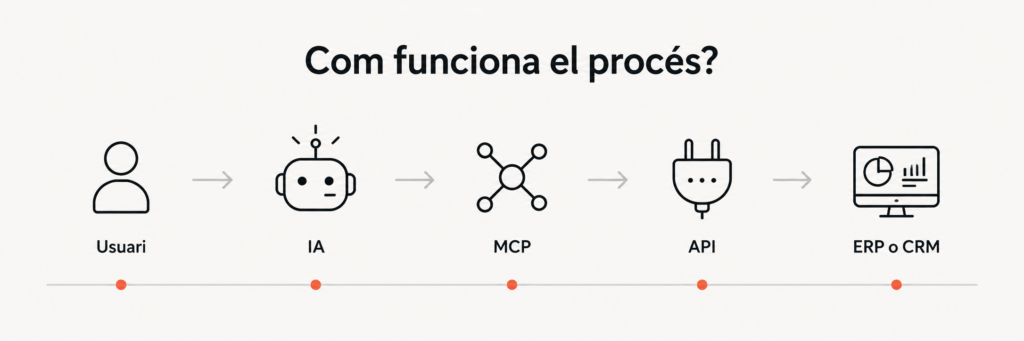
How does the process work?
The journey can be represented like this:
User → AI → MCP → API → ERP or CRM
The response returns in the opposite direction:
ERP or CRM → API → MCP → AI → User
The user asks a question in natural language. The AI interprets what is needed, checks the available tools via MCP, and selects the appropriate one. This tool uses the API to access the system, obtain the data, and return it to the AI.
An example: checking stock
Imagine a person asks an assistant:
“How many units do we have of product X?”
The AI understands that it needs to check the stock. Thanks to MCP, it knows it has a tool to perform this query and what information it needs to use it.
The tool connects to the ERP’s API and requests the stock for the product. The ERP queries its data and responds that there are 24 units available.
Finally, the AI presents the answer to the user in an understandable way:
“There are currently 24 units of product X available.”
The user can obtain updated data from the ERP without entering the system, searching for the product, or knowing how its API works.
What would happen if there were no MCP?
Without MCP, the AI could also connect to the ERP’s API. But a specific integration would need to be developed to explain what operations exist, how to use them, and how to interpret each response.
The process would be:
User → AI → custom integration → API → ERP
MCP provides a standard way to present these tools to artificial intelligence applications. This makes connections more orderly, modular, and reusable.
It does not eliminate the need to develop the integration with the ERP or CRM, but it avoids having to design the entire connection from scratch for each AI application.
And if the system does not have an API?
MCP needs some way to reach the data. If the ERP or CRM does not have an API, an alternative must be created, such as a custom connector, controlled database access, or a file exchange system.
In this case, the process would be:
User → AI → MCP → custom connector → ERP
MCP does not create data access by itself. It organizes and presents the available tools to the AI, but it needs a technical gateway to communicate with the system.
What value does MCP provide?
MCP allows moving from a generic artificial intelligence to an AI connected to the company’s reality.
This makes it possible to query updated information using natural language, execute actions on corporate systems, and define which data and functions each assistant can use.
A company can decide, for example, that the AI only queries information or also allow it to create orders, update customers, or open support tickets. It can also establish permissions and confirmations for more sensitive actions.
Connecting AI with real business processes
MCP does not replace ERP, CRM, APIs, or integrations. Its value is to offer a standard way for artificial intelligence to understand what tools it has available and how it can use them.
At DMS3, we help companies identify which data and processes make sense to connect with artificial intelligence, develop the necessary integrations, and define secure access adapted to their operations.