
What you need to do before June 2026
From June 19, 2026, companies that sell products or contract services online with consumers will have to facilitate the exercise of the right of withdrawal directly from their website through a visible, accessible and easy-to-use functionality. The objective of the regulation is clear: canceling a purchase must be as easy as making it .
Although the right of withdrawal already existed, this modification forces many companies to review their digital processes, their legal conditions and even some of the integrations that connect their eCommerce with the rest of the business.
The regulation affects any eCommerce regardless of the platform used. Whether you work with WordPress and WooCommerce, Shopify, Logicommerce or a custom solution, the important thing is to ensure that the consumer can exercise this right in a visible, accessible and unobstructed way.
What exactly is the right of withdrawal?
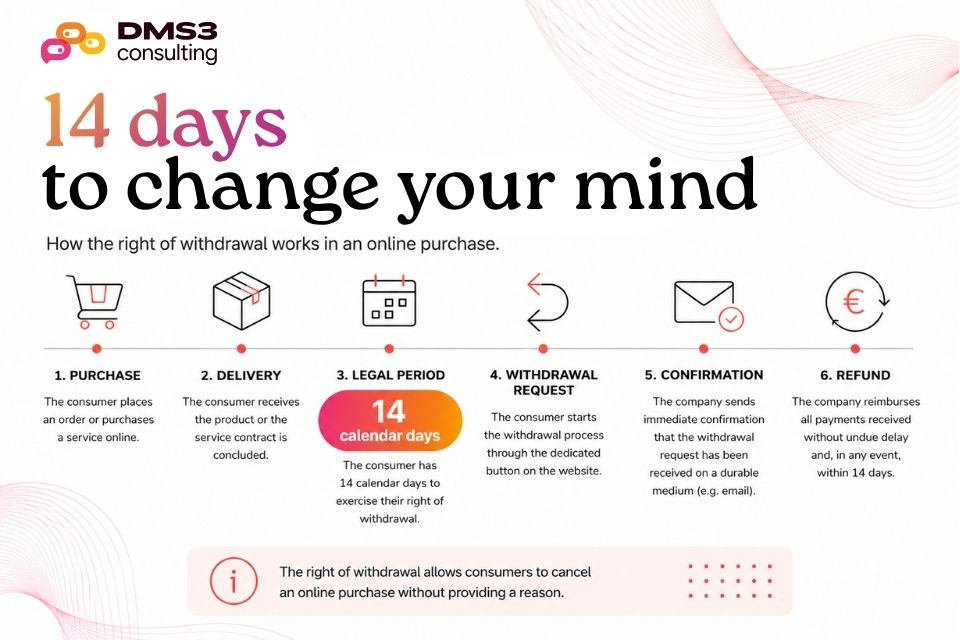
The right of withdrawal allows a consumer to cancel a purchase or a contract concluded at a distance without having to justify the reason.
In most cases, the period is 14 calendar days . In the sale of products, this period begins when the customer receives the order. In services, the calculation begins from the moment the contract is formalized.
This right is part of European consumer protection legislation and seeks to guarantee that users have a reflection period after an online purchase.
What changes from June 2026?
The right of withdrawal is not new . What changes is the way in which companies must allow it to be exercised.
Until now, it was common for the user to have to look for an email, fill out a contact form or contact customer service to start the process. With the new regulations, online platforms will have to incorporate a specific functionality so that the consumer can opt out directly from the digital interface itself .
This functionality must be visible, easy to locate and available throughout the withdrawal period. Furthermore, once the right has been exercised, the consumer must receive immediate confirmation on a durable medium, such as email.
Who is required to incorporate the opt-out button?
The new obligation affects any business that formalizes online contracts with end consumers and that is subject to the right of withdrawal .
In practice, this includes a large part of today’s digital businesses:
- Online stores for physical products.
- eCommerce developed with Shopify, WooCommerce, Prestashop or custom solutions.
- Subscription services.
- Consumer-oriented SaaS platforms.
- Online academies and training platforms.
- Marketplaces.
- Mobile applications that allow you to contract services or products.
However, not all digital businesses are obliged to do so. The regulations maintain several exceptions to the right of withdrawal that already existed previously.
This is particularly relevant for activity booking platforms. If a company sells hotel reservations, leisure activities with a specific date, tickets for shows or similar services, the right of withdrawal may not apply. For this reason, the obligation cannot be determined solely by the type of platform, but rather by analyzing the specific services that are contracted there.
Case | Do you have a right of withdrawal? |
|---|---|
Buying clothes online | Yes |
Electronics purchase | Yes |
Digital subscription | Yes |
Online course not started | Yes |
Customized product | No |
Concert or show ticket | No |
Hotel reservation | No |
Tourist activity with specific date | Usually not |
Digital content already downloaded with express consent | No |
What happens if you don’t comply with the regulations?
The inclusion of the opt-out button is not simply a good practice. It is part of European consumer protection regulations and failure to comply with it can have significant consequences .
Sanctions can reach up to 4% of the company’s annual turnover in certain widespread infringements, especially when they systematically affect consumer rights.
In addition, there is a consequence that many companies are unaware of: if the consumer has not been correctly informed about their right of withdrawal or if the process is excessively difficult, the legal period of 14 days can be extended up to an additional 12 months .
But the risk is not only legal. A confusing return or cancellation process generates incidents, increases the administrative burden and damages customer trust . In a context where the digital experience is a differentiating factor, compliance with regulations is also a matter of reputation.
How to properly implement the unsubscribe button
Adding a button to your website is probably the easiest part of the process.
The real challenge is to ensure that withdrawal is integrated into the business operations. Whether in projects developed with WooCommerce , Shopify , Logicommerce or custom platforms, the goal is not only to comply with regulations, but also to ensure that returns, cancellations and customer communications are managed efficiently.
For this reason, many companies will need to review not only their eCommerce platform, but also integrations with ERP, CRM, logistics systems and customer service tools.
The regulation is a legal obligation, but also an opportunity to review processes and build a more transparent and efficient shopping experience.
