
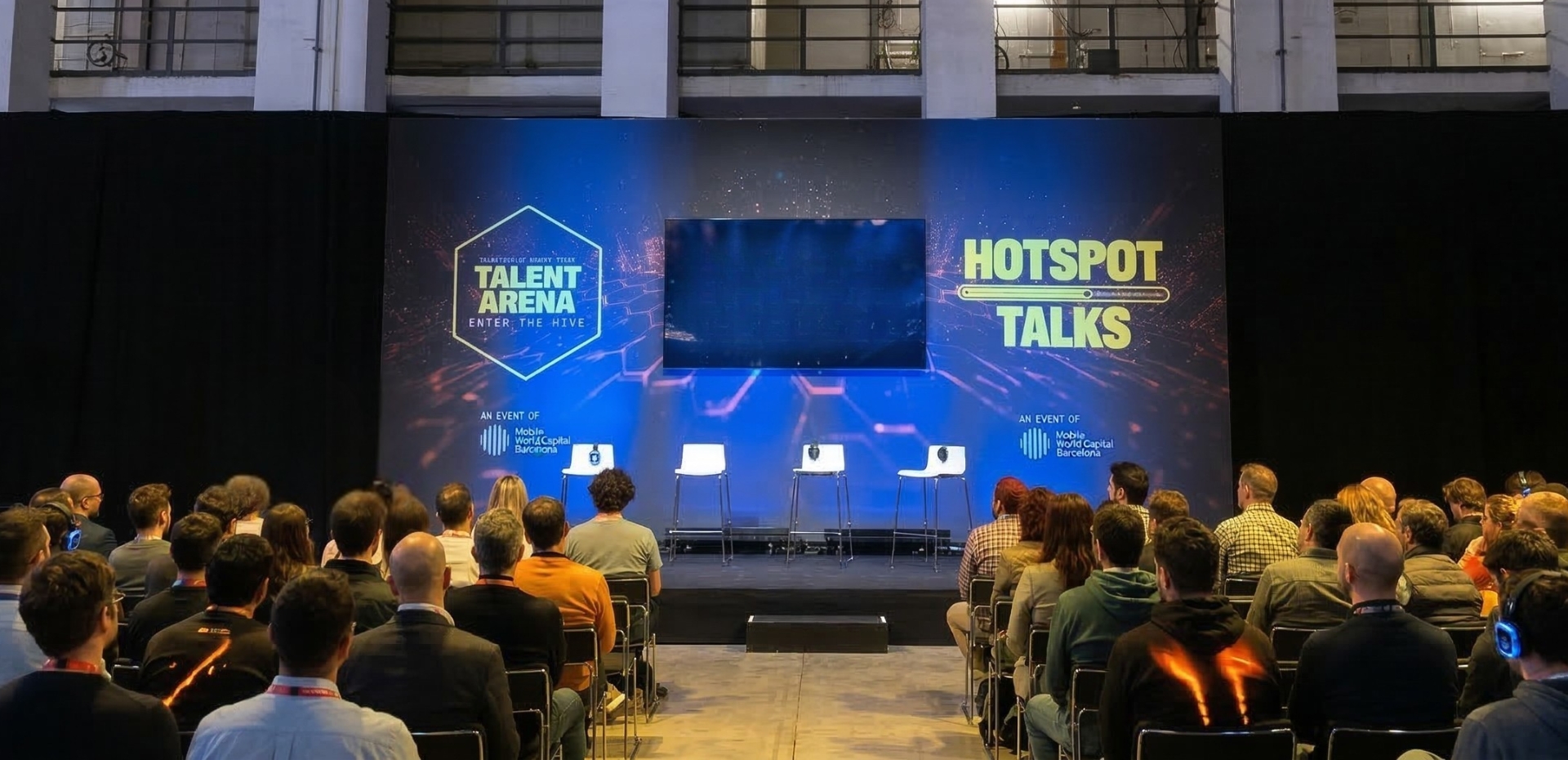
After one of the conferences we attended at the Talent Arena in Barcelona , there remains an idea that is difficult to ignore: perhaps the future does not only involve more technology, but also recovering a more humanistic view of knowledge.
La ponència de Xisca Sorell Llull —Senior AI Product Manager i Data Scientist— girava al voltant d’una reflexió central: amb el temps hem anat fragmentant massa la ment. Durant segles, el coneixement no estava compartimentat. El científic també podia ser filòsof, l’artista podia ser enginyer i el matemàtic podia dialogar amb la música. The Renaissance was not just an artistic movement, but a way of understanding the world based on the connection between disciplines.
With the advent of the industrial revolution, however, this vision was transformed. Mass production brought with it a much more specialized organization of work, and knowledge was progressively divided into increasingly specific areas. Hyperspecialization became the norm and the system was structured around efficiency, productivity and the segmentation of knowledge. For decades we have operated under this paradigm, but the arrival of artificial intelligence is beginning to question it .
The myth of the winged chariot and our imbalance
To explain this moment of change, Xisca recovered Plato’s myth of the winged chariot . In this metaphor, reason is the driver who tries to govern two horses: one represents passion and the other duty. The balance between these two impulses is delicate and requires constant control.
In a way, our educational and professional system has tended to separate these two horses, often forcing us to choose between passion or stability, creativity or rigor, art or technology. However, this division has perhaps never been entirely natural.
In areas such as digital design this is clearly perceived. UX/UI design, for example, does not move only in the visual or creative realm, but also constantly dialogues with technology, programming and human behavior . Understanding code can improve the ability to design coherent digital systems, just as understanding the human experience allows us to build more meaningful technological products.
Perhaps it is precisely here that one of the keys to what we could call a Renaissance 2.0 is found.
Artificial Intelligence is not an oracle
One of the most suggestive metaphors of the talk compared artificial intelligence to a small child. It is an extraordinarily intelligent child, capable of learning very quickly and with processes increasingly similar to those of the human mind, but which continues to need guidance .
AI has not evolved alone. Behind its development are engineers, but also psychologists, sociologists, doctors, linguists and educators. In other words, professionals from very diverse fields who provide knowledge and criteria so that the technology can advance.
Therefore, thinking of artificial intelligence as an autonomous or self-sufficient system can be a dangerous simplification. Technology does not advance in a vacuum; it always does so within a cultural and human context . As in classical or biblical myths, the creation of a powerful tool can carry the implicit risk of hubris, the overconfidence that makes one forget the responsibility of the one who creates it.
In this sense, AI should not dictate our future, but rather help us build it or with more knowledge and greater decision-making capacity.
The return of hybrid minds
Towards the end of the talk, an inevitable question appeared: if the future seems to require more transversal knowledge, how can new generations be guided?
The answer pointed towards a clear combination: understanding technology while cultivating what each person is truly passionate about. It’s not so much about knowing everything as it is about being able to connect different knowledge.
In disciplines like user experience design this becomes especially evident. The work is not just about designing screens, but about creating relationships between people and digital systems. This involves understanding psychology, business, technology, narrative, and even ethical issues.
Hyperspecialization has been useful for building efficient systems, but the hybridization of knowledge may be what allows value to be generated in an increasingly complex technological context .
He who knows everything conquers all.
A Latin phrase quoted during the talk summarizes this idea well: Omnia vincit qui omnia scit – ” He who knows everything conquers everything .”
It is not about understanding everything in a literal sense or accumulating superficial knowledge, but rather about cultivating a broad perspective that allows us to relate disciplines and avoid fragmentation of the mind. Artificial intelligence, in fact, is beginning to erase many of the boundaries we had built between fields of knowledge.
The question is whether we are also willing to do it.
Perhaps the true Renaissance 2.0 is not only technological, but mental : a way to reunite passion, knowledge and responsibility to drive—as in the myth of the winged chariot—the two horses with balance.
