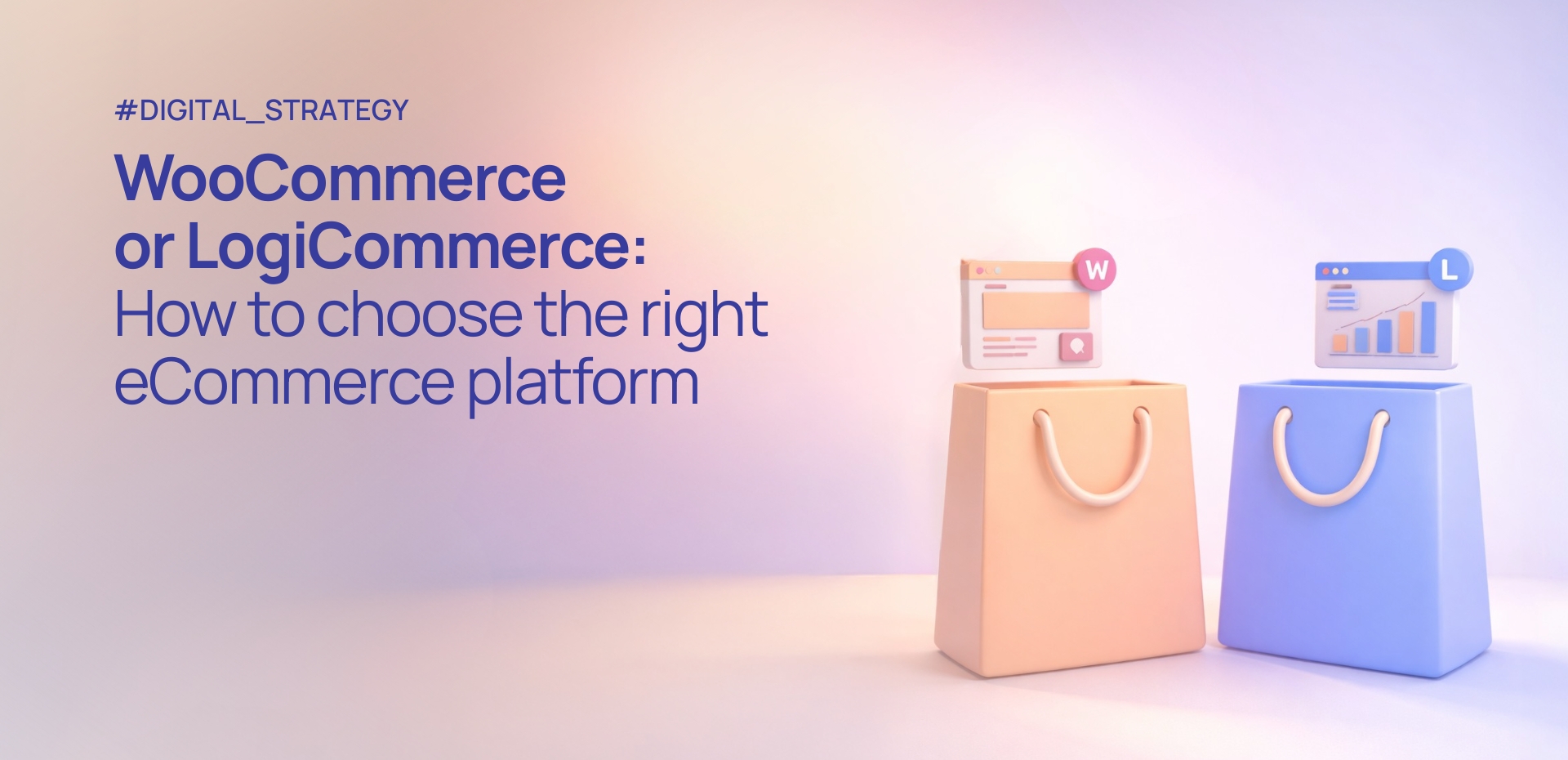
Choosing an eCommerce platform is a strategic decision. It doesn’t only affect how you sell online, but also how the business can evolve, the level of complexity it will take on over time, and its ability to adapt to new scenarios. This is where the question arises: WooCommerce or LogiCommerce?
At DeMomentSomTres, we work with eCommerce projects of very diverse natures, and if there is one clear conclusion, it is this:
The platform must be aligned with the reality and goals of the business, not the other way around.
In this article, we analyse WooCommerce and LogiCommerce, two commonly used solutions in the Catalan and Spanish markets, to understand in which contexts each one makes sense.
The importance of a preliminary diagnosis
Before talking about specific platforms, at DeMomentSomTres we always work from a clear foundation:
- Understanding how the business operates today.
- Identifying where it aims to evolve.
- And identifying potential future limitations.
Only with this perspective is it possible to recommend a coherent technological solution. Comparisons can help, but they do not replace an analysis of each company’s real context.
Two platforms with different approaches
Although both allow you to sell online, WooCommerce and LogiCommerce are based on different approaches.
WooCommerce: flexibility and adaptability
WooCommerce is a WordPress-based solution that stands out for its flexibility and its wide ecosystem of extensions. It is particularly common in projects that require:
- A gradual entry into eCommerce,
- A controlled initial investment,
- The ability to adapt in the short term.
It is commonly used in:
- Small and medium-sized businesses,
- B2C projects,
- Businesses where content and digital communication play a relevant role.
WooCommerce allows for the creation of very diverse solutions, but it requires a solid initial definition to ensure the project can evolve in an orderly way as needs grow.
LogiCommerce: structure and medium- to long-term vision
LogiCommerce is an eCommerce platform designed for companies with a more structured operation or with specific growth needs.
It is commonly used in:
- medium-sized or large companies,
- B2B or hybrid models (B2B and B2C),
- projects with a presence in multiple markets,
- environments where eCommerce needs to be integrated with internal processes.
Here, eCommerce is not conceived as a standalone tool, but as an integrated part of the organisation, prepared to respond to more complex scenarios from the very beginning.
It’s not a question of “better” or “worse”
A common mistake is to approach this decision in absolute terms. In practice, neither of the two platforms is universally better.
What really makes the difference is:
- the business model,
- the volume of operations,
- the commercial complexity,
- and growth projections.
and growth projections.
When discussing eCommerce platforms, the focus is often placed solely on the initial cost. However, experience shows that it is more relevant to analyse the total cost over time.
- Some solutions allow you to start with a lower investment, but require greater technical involvement as the project grows.
- Others involve a more structured investment, but provide a foundation that is ready to evolve without continuous changes.
Neither approach is wrong in itself. The key is to understand which one best fits the current stage of the business.
